Have you ever heard of a kangaroo that lives in trees? It might sound like something from a storybook, but these incredible animals are very real. Tree kangaroos are unique marsupials that call the rainforests of Australia and New Guinea their home.
Unlike their famous ground-dwelling cousins, these amazing creatures spend most of their time high up in the forest canopy. They have adapted in remarkable ways to this treetop lifestyle.
In this article, we will explore everything you need to know about tree kangaroos. We will look at their behavior, their habitat, and the serious threats they face. More importantly, we will discover how we can help them.
These fascinating animals are not just a curiosity. They play a vital role in their ecosystem and are an important part of our world’s biodiversity. Join us as we learn more about these extraordinary marsupials.
Table of Contents
What Exactly is a Tree Kangaroo?
Tree kangaroos are members of the Macropod family, the same group that includes kangaroos and wallabies . Their scientific name is Dendrolagus, which fittingly means “tree hare” . They are distinguished from other macropods by their adaptation to life in the trees, known as an arboreal lifestyle .
The story of tree kangaroos is one of evolutionary wonder. The ancestors of all kangaroos were once tree-dwelling creatures . Over millions of years, many of them came down to live on the ground. However, the ancestors of tree kangaroos climbed back up into the trees. This is why they have a unique mix of features suited for both the forest floor and the canopy .
This return to the trees happened as ancient forests changed and developed in New Guinea and Australia. These clever marsupials are now the largest tree-dwelling mammals in Australia .
Where Do Tree Kangaroos Live? Their Rainforest Home
Tree kangaroos are found in two main regions: the tropical rainforests of northeastern Australia and the island of New Guinea . Their habitat includes both lowland areas and mountainous regions up to 10,000 feet . In Australia, you can find two species in the Wet Tropics of Far North Queensland.
The Lumholtz’s tree kangaroo lives south of the Daintree River to the Cardwell Range . The Bennett’s tree kangaroo is found north of the Daintree River . New Guinea is home to the remaining species, which are often found in remote, mountainous areas . Because these forests are dense, tree kangaroos are often hard to spot .
How Many Species of Tree Kangaroos Are There?
There are 14 recognized species of tree kangaroos, although scientists sometimes debate the exact number due to subspecies . They all belong to the genus Dendrolagus . Each species has its own unique characteristics and markings.
The two Australian species are Lumholtz’s and Bennett’s tree kangaroos . In New Guinea, the species include the striking Goodfellow’s tree kangaroo, the endangered Tenkile, and the Dingiso, which locals consider a spirit animal . Species like the Wondiwoi tree kangaroo are so rare they were thought to be extinct until very recently .
Built for the Canopy: Tree Kangaroo Adaptations
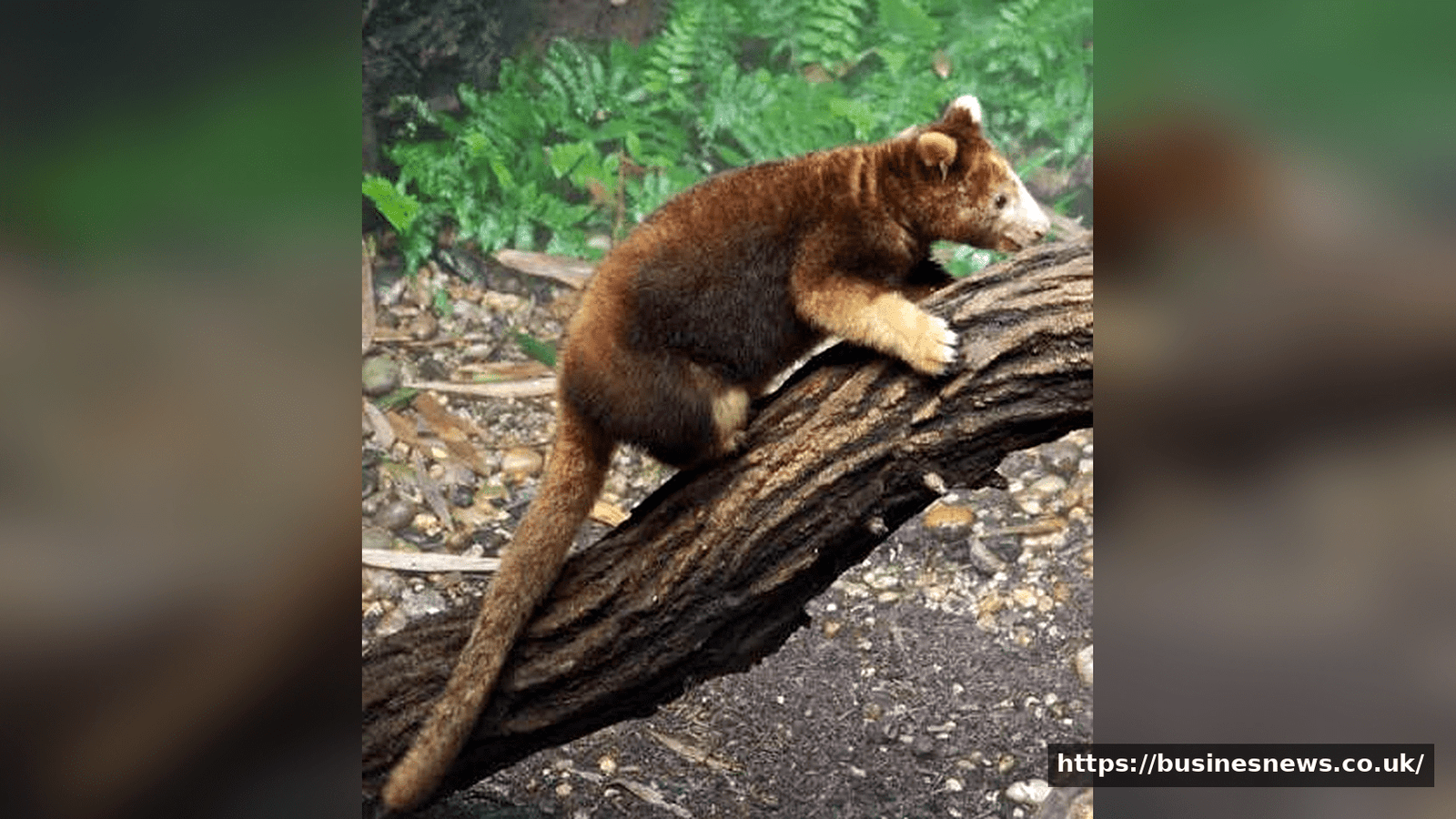
Tree kangaroos have evolved specific physical traits to survive in the trees . They have muscular forelimbs and shorter hind legs than ground kangaroos. These strong arms help them climb and hold onto branches .
Their feet have curved claws and soft, rubbery pads. This gives them excellent grip on tree trunks and limbs . Unlike other kangaroos, they can move their hind legs independently. This helps them walk forward and backward along branches . They also have long, bushy tails for balance, but they cannot grip with them .
What Do Tree Kangaroos Eat?
Tree kangaroos are mainly herbivores . Their diet consists primarily of leaves, fruits, and flowers from rainforest trees . They have large stomachs that help them ferment and digest the tough leaves they eat .
They are selective eaters and will choose leaves from many different plant species. Lumholtz’s tree kangaroos, for example, eat from over 140 rainforest plants . Occasionally, they may also eat other items like eggs, sap, or bark .
Are Tree Kangaroos Nocturnal?
Tree kangaroos are often thought to be nocturnal, but this is not always true. Lumholtz’s tree kangaroos are cathemeral, which means they are active both during the day and at night . This contradicts a common myth that they are strictly nocturnal .
They often spend the day resting, curled up on a horizontal branch . They will then move around to feed at different times, depending on the season and temperature. They are generally solitary and shy animals, and they can be hard to observe .
What are the Main Threats to Tree Kangaroos?
Tree kangaroos face many serious threats, and most species are declining . The biggest threat is habitat loss from logging and land clearing for agriculture . This destroys their rainforest homes and leaves their populations fragmented.
In addition, hunting by local people for food is a significant threat, especially in New Guinea . The introduction of guns and dogs has made hunting more efficient. In some places, tree kangaroos also face risks from predators like pythons and wild dogs .
Are Tree Kangaroos Endangered?
The conservation status of tree kangaroos varies by species. The International Union for Conservation of Nature (IUCN) lists the Tenkile as “Critically Endangered.” Its population dropped to as low as 100 animals at one point . It has since recovered to around 300, but it is still in great danger.
The Lumholtz’s and Bennett’s tree kangaroos are listed as “Near Threatened” in Australia . The Wondiwoi tree kangaroo is also considered critically endangered and is one of the rarest mammals on Earth .
Conservation Efforts: Protecting Tree Kangaroos
Many organizations are working hard to protect tree kangaroos. In New Guinea, the Tenkile Conservation Alliance has been crucial. They created a hunting moratorium for villagers and provide alternative protein sources like rabbits .
Another program, the Tree Kangaroo Conservation Program, protects the Matschie’s tree kangaroo . They have established community-based conservation areas. In Australia, groups like the Tree Kangaroo and Mammal Group are working with landowners to create wildlife corridors and plant trees .
The Two Australian Species: A Closer Look
Australia is home to two unique species of tree kangaroos. The Lumholtz’s tree kangaroo is the smallest of the 14 species . It has a distinctive black facial mask and a buffy forehead . It lives in the Atherton Tablelands region .
The Bennett’s tree kangaroo is larger and has a rusty nape . It is found exclusively in the area north of the Daintree River . Both species are folivores and are vital to the health of the Wet Tropics rainforests.
Tree Kangaroo Evolution: A Tale of Two Worlds
The evolution of tree kangaroos is a fantastic story of adaptation. All kangaroos evolved from tree-dwelling possum-like ancestors . When Australia became drier, these ancestors came down from the trees to live on the open plains.
Ground kangaroos evolved strong hind legs for efficient hopping. However, some of these ancestors migrated to New Guinea and Australia’s tropical forests. There, they found a new home in the trees. They evolved features like strong forelimbs and shorter hind legs to thrive in the canopy .
How Do Tree Kangaroos Reproduce?
Tree kangaroos have a slow reproductive rate compared to their ground-dwelling cousins . They usually give birth to just one joey per year . This low birth rate makes it hard for their populations to recover from threats.
The joey stays in the mother’s pouch for about nine months. It will then continue to stay with its mother for up to two and a half years, learning how to survive . This extended parental care is a key part of their life cycle .
Key Details About Tree Kangaroos
Here is a quick summary of some key facts and details about these amazing animals.
| Feature | Details |
| Scientific Name | Dendrolagus |
| Number of Species | 14 recognized species |
| Location | Rainforests of Australia, Papua New Guinea, and Indonesia |
| Habitat | Tropical lowland and mountainous rainforests |
| Diet | Herbivores, eating leaves, fruits, and flowers |
| Size | Head and body: 16-30 in; Tail: 16-34 in; Weight: up to 32 lbs |
| Lifespan | Unknown in the wild, but can live over 20 years in zoos |
| Reproduction | One joey born per year; pouch life is approximately 9 months |
| Main Threats | Habitat loss, hunting, and climate change |
| Conservation Status | Ranges from “Near Threatened” to “Critically Endangered” |
Conclusion
Tree kangaroos are some of the most remarkable and unique animals on our planet. They represent an incredible story of evolution and adaptation to life in the rainforest canopy. From their strong, climbing arms to their independent back legs, they are perfectly designed for their treetop home.
However, these amazing marsupials are fighting for survival. The biggest threats to tree kangaroos are habitat destruction and hunting. Many species are now endangered, and their future depends on our help. Their slow reproductive rate makes it even harder for them to bounce back from population declines.
Conservation efforts are making a real difference. By protecting their rainforest homes and working with local communities, we can help tree kangaroos thrive. Learning about these animals is the first step to protecting them.
Share this article to help raise awareness for tree kangaroo conservation. Their future is in our hands.
Frequently Asked Questions
Can tree kangaroos jump from trees?
Yes! Tree kangaroos are expert leapers. They have been recorded making downward jumps of up to 9 meters from one tree to another . They can also jump to the ground from heights of 18 meters or more without injuring themselves . They are incredibly agile in their treetop habitat.
What is the main difference between a tree kangaroo and a kangaroo?
The main difference is their lifestyle and physical adaptations. Ground kangaroos have strong hind legs for hopping across open plains. Tree kangaroos have stronger forelimbs and shorter hind legs for climbing. They also have curved claws and padded feet for gripping branches .
Are tree kangaroos aggressive?
Tree kangaroos are generally solitary and shy animals. They are not typically aggressive towards humans. Males can be territorial and will defend their home range from other males. This is a natural behavior to compete for mates and resources .
What is being done to save tree kangaroos?
Many conservation groups are working to help tree kangaroos. They work with local communities to create hunting moratoriums . They also help restore and protect the rainforest habitat. This includes planting trees to create wildlife corridors and raising public awareness .
How do tree kangaroos climb down trees?
Unlike many other animals, tree kangaroos can climb down trees head first. They are the only macropods that can move their hind legs independently. This allows them to walk forward and backward along branches. They can also rotate their ankles to help them climb down trunks .
What do tree kangaroos eat in the wild?
Tree kangaroos are herbivores with a diet mostly made up of leaves, fruits, and flowers . In Australia, Lumholtz’s tree kangaroos feed on the leaves of over 140 different rainforest plant species . This makes them a vital part of their ecosystem.