Understanding company classification sectors verticals examples is important for business owners, investors, students, and professionals. Every company operates within a specific part of the economy. To organize businesses better, experts group companies into sectors, industries, and verticals. These classifications help people compare businesses, analyze markets, identify competitors, and make smarter investment decisions.
In my experience working with business research and market analysis, many people confuse sectors and verticals. While they sound similar, they serve different purposes. A sector is a broad category of economic activity, while a vertical is a specialized market within an industry. Knowing these differences helps companies improve marketing, sales, and growth strategies.
This guide explains company classification sectors verticals examples in simple language. You will learn how business classifications work, why they matter, and how major companies fit into different categories.
Table of Contents
What Is Company Classification?
Company classification is the process of grouping businesses based on their products, services, operations, or target markets. Governments, investors, and analysts use classification systems to organize companies into meaningful categories.
These classifications make it easier to study economic trends and compare businesses. For example, a bank and a software company operate differently, so they belong to different sectors.
A clear classification system helps:
- Investors evaluate opportunities
- Businesses identify competitors
- Governments track economic activity
- Researchers analyze industries
- Customers understand markets
When discussing company classification sectors verticals examples, it is important to understand that classifications often follow a hierarchy from broad sectors to specific vertical markets.
Understanding Business Sectors
A business sector is one of the broadest categories in company classification. Sectors group businesses that perform similar economic activities.
For example, all banking, insurance, and investment firms belong to the financial sector. Likewise, software companies, hardware manufacturers, and IT service providers belong to the technology sector.
Common Business Sectors
| Sector | Main Activity | Example Companies |
| Technology | Software and IT services | Microsoft, Apple |
| Healthcare | Medical services and products | Pfizer, Johnson & Johnson |
| Financial Services | Banking and investments | JPMorgan Chase |
| Consumer Goods | Everyday products | Procter & Gamble |
| Energy | Oil, gas, and renewable power | ExxonMobil |
| Industrials | Manufacturing and engineering | Caterpillar |
| Telecommunications | Communication services | Verizon |
| Utilities | Water, electricity, gas | Duke Energy |
| Real Estate | Property development | Simon Property Group |
| Materials | Mining and raw materials | Dow Inc. |
These sectors form the foundation of most company classification sectors verticals examples used worldwide.
What Is an Industry?
An industry is a narrower category within a sector. Companies in the same industry offer similar products or services.
For example:
- Sector: Technology
- Industry: Software Development
Another example:
- Sector: Healthcare
- Industry: Pharmaceutical Manufacturing
Industries allow more precise comparisons between companies. Investors often compare businesses within the same industry because they face similar market conditions.
What Is a Business Vertical?
A business vertical refers to a specialized market segment that serves a particular customer group or industry.
Unlike sectors, verticals focus on specific customer needs.
For example, a software company may create products for:
- Healthcare
- Education
- Banking
- Manufacturing
Each of these becomes a separate vertical market.
When examining company classification sectors verticals examples, verticals provide deeper insights into a company’s target audience and expertise.
Difference Between Sectors, Industries, and Verticals
Many people use these terms interchangeably, but they have different meanings.
| Category | Definition | Scope |
| Sector | Broad economic category | Very broad |
| Industry | Group of similar businesses | Moderate |
| Vertical | Specific customer market | Narrow |
| Niche | Highly specialized area | Very narrow |
Example
| Classification Level | Example |
| Sector | Technology |
| Industry | Software Development |
| Vertical | Healthcare Software |
| Niche | Electronic Health Record Software |
This hierarchy makes company classification sectors verticals examples easier to understand.
Why Company Classification Matters
Business classification helps organizations make informed decisions. Investors use classifications to diversify portfolios. Companies use them to identify opportunities and competitors.
Benefits include:
- Better market research
- Easier competitor analysis
- Improved investment decisions
- Stronger marketing strategies
- Enhanced business planning
Without proper classification systems, comparing businesses across industries would be extremely difficult.
Major Sector and Vertical Examples
The following table shows practical company classification sectors verticals examples.
| Sector | Industry | Vertical Example |
| Technology | Software | Healthcare Software |
| Technology | Cloud Computing | Financial Cloud Services |
| Healthcare | Pharmaceuticals | Cancer Treatment Solutions |
| Financial Services | Banking | Small Business Banking |
| Retail | E-commerce | Fashion Retail |
| Education | EdTech | Online Learning Platforms |
| Manufacturing | Industrial Equipment | Automotive Manufacturing |
| Energy | Renewable Energy | Solar Energy Solutions |
| Real Estate | Property Management | Commercial Real Estate |
| Agriculture | Farming | Organic Food Production |
Technology Sector Vertical Examples
The technology sector contains many specialized verticals. Software companies often focus on specific industries rather than serving everyone.
Examples include:
- FinTech for financial services
- HealthTech for healthcare providers
- EdTech for schools and universities
- LegalTech for law firms
- PropTech for real estate businesses
Many successful software companies grow faster because they specialize in one vertical before expanding into others.
This is one of the strongest modern company classification sectors verticals examples because technology touches nearly every industry.
Healthcare Sector Vertical Examples
Healthcare is one of the world’s largest sectors. Within healthcare, many verticals focus on specialized medical needs.
Examples include:
- Telemedicine
- Medical devices
- Hospital management software
- Pharmaceutical research
- Health insurance services
Each vertical serves a unique audience and solves specific healthcare challenges.
Healthcare companies often create highly specialized products, making vertical expertise extremely valuable.
Financial Services Sector Vertical Examples
The financial services sector includes banks, insurers, lenders, and investment firms. Within this sector, businesses target specific customer groups.
Examples include:
- Retail banking
- Corporate banking
- Wealth management
- Mortgage lending
- Digital payments
- Cryptocurrency services
Understanding these verticals helps investors evaluate financial companies more accurately.
Many analysts rely on company classification sectors verticals examples when comparing financial institutions.
How Investors Use Company Classifications
Investors depend heavily on sector and industry classifications. They use classifications to reduce risk and diversify portfolios.
For example, investing only in technology companies creates concentration risk. By spreading investments across healthcare, energy, technology, and consumer goods sectors, investors can achieve better balance.
Classification systems also help identify emerging opportunities. If renewable energy grows rapidly, investors can focus on that specific sector and its verticals.
This approach makes business classifications a powerful investment tool.
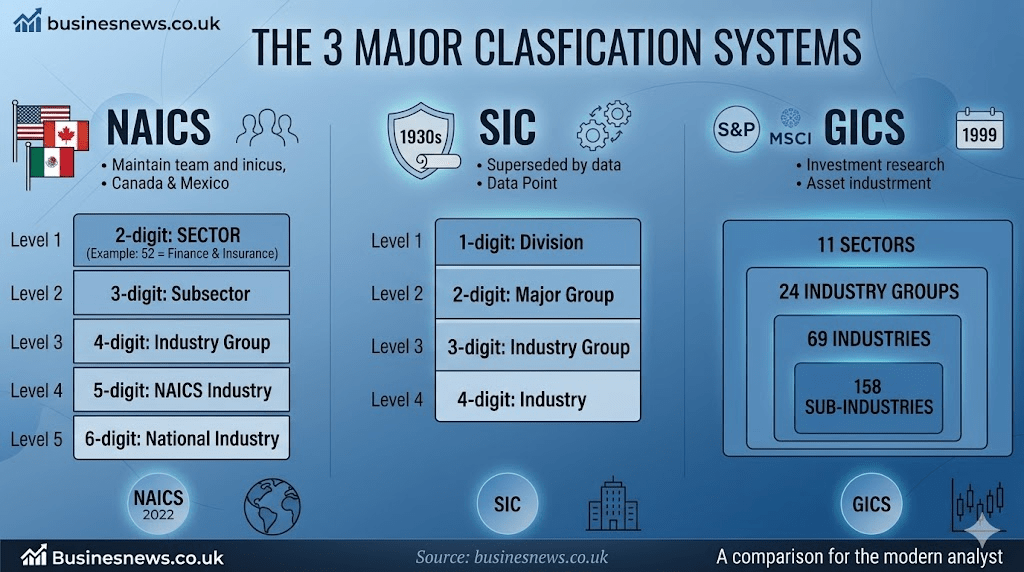
Popular Company Classification Systems
Several organizations maintain standardized classification frameworks.
Common Classification Systems
| System | Purpose |
| GICS | Global Industry Classification Standard |
| NAICS | North American Industry Classification System |
| SIC | Standard Industrial Classification |
| ICB | Industry Classification Benchmark |
These systems create consistency across financial reports, market research, and economic studies.
Most professional discussions about company classification sectors verticals examples rely on one of these frameworks.
How Businesses Choose Their Vertical
Selecting the right vertical can significantly impact growth. Companies often start broad and later specialize.
Factors influencing vertical selection include:
- Customer demand
- Market size
- Competition level
- Expertise
- Revenue potential
- Regulatory requirements
In my experience, companies that clearly understand their vertical often create stronger customer relationships because they solve industry-specific problems more effectively.
Future Trends in Company Classification
Business classifications continue evolving as new technologies emerge. Artificial intelligence, blockchain, cybersecurity, and sustainability have created entirely new vertical markets.
Future classifications may include:
- AI Solutions
- Climate Technology
- Green Energy Services
- Digital Health Platforms
- Smart Manufacturing
- Autonomous Transportation
As industries evolve, new company classification sectors verticals examples will continue appearing across the global economy.
Frequently Asked Questions
1. What is the difference between a sector and a vertical?
A sector is a broad economic category, while a vertical is a specific market segment within an industry.
2. Why are company classifications important?
They help investors, businesses, and researchers analyze markets, competitors, and growth opportunities.
3. What are examples of business sectors?
Technology, healthcare, financial services, energy, real estate, and consumer goods are common sectors.
4. What is a vertical market example?
Healthcare software is a vertical market within the software industry.
5. Which classification system is most widely used?
GICS is one of the most widely used systems among investors and financial institutions.
6. Can a company operate in multiple verticals?
Yes. Many companies serve several vertical markets while remaining within one primary industry.
Conclusion
Understanding company classification sectors verticals examples provides valuable insight into how businesses operate and compete. Sectors represent broad economic categories, industries narrow the focus, and verticals target specific customer needs. Together, these classifications create a structured view of the business world.
Whether you are an investor researching opportunities, a student learning business concepts, or a company planning growth, understanding sectors and verticals can improve decision-making. As markets evolve and new technologies emerge, business classifications will continue adapting to reflect changing economic realities. Mastering these concepts today will help you better understand tomorrow’s business landscape.